
Discovering Sweetgale (myrica gale)? Taste its flavour — straight from our northern landscapes.
What is sweet gale?
Sweet gale (Myrica gale) is a shrub native to Quebec's bogs and wetland shores. In spring, it produces catkins — the plant's male flowers, shaped like small, dense conical structures — which are harvested and dried to make a boreal spice with an absolutely captivating fragrance: resinous, camphorated, lightly peppery, with hints of bay leaf and nutmeg.
It is one of the most complex spices in the Quebec boreal forest — and one of the most potent. That's what makes it a fascinating ingredient to cook with, once you understand it.
A sublime fragrance… and a bitterness to respect
Sweet gale has two faces. On one side, an aroma of rare richness: woody, warm, resinous — wrapping a dish in an aromatic depth that's hard to achieve with any other spice. On the other, a frank bitterness — more pronounced than most spices — that can quickly dominate a dish if you're not mindful of it.
The golden rule: pair it with sweet or fatty ingredients, or use it sparingly.
With a well-reduced beef broth, braised lamb, or caramelized onion soup, the bitterness melds into umami flavors and fats, and the sweet gale's fragrance comes fully into its own. Same goes for a boldly flavored sweet preparation — a caramel or a tart fruit compote, for instance. In dishes with too delicate or mild a flavor profile, it can easily take over.
What does it taste like?
The aromatic profile of sweet gale catkins evokes:
- Resin and camphor — fresh, sharp, immediately recognizable
- Wood — deep, warm
- Bay leaf and nutmeg — lightly spiced, rounded
- A bitterness that is clean and persistent, adding structure to the dish
It's a spice that "signs" a dish. Even in small doses, it's unmistakable.
A long culinary history
Humans discovered long ago that sweet gale is edible, and it has been used in cooking for centuries — most notably as a flavoring in traditional European ales (the famous gruit) well before hops became widespread. (Yes, the plant also grows in Europe!)
Indigenous peoples used it to flavor foods, as an insect repellent, and for its traditional digestive properties. In culinary quantities, it is perfectly safe. Like any potent spice, excessive consumption is not recommended — but a few catkins in a dish pose no issue whatsoever.
How to prepare sweet gale catkins
Catkins are sold whole and prepared by hand. Before using them, break them apart between your fingers or grind them in a mortar to release their essential oils and aromas.
You'll get small, slightly sticky granules — that's the catkin's natural resin. Don't expect a fine, dry powder: it's this resinous texture that concentrates all the spice's fragrance.
How to use it in cooking
In broths and stews — add a small amount of crushed catkins to a meat broth, onion soup, or game stew. As you would with a clove, you can also use them whole and remove before serving. Note: too long an infusion can release excess bitterness — taste and adjust as you go.
As a rub for red meats — mix ground sweet gale with salt, black pepper, and a little brown sugar. The spice's bitterness is balanced by the meat's fat and the caramelization during cooking.
In terrines and pâtés — a few catkins tucked into the mixture before cooking add a remarkable aromatic depth.
In sweets — a salted butter caramel or a tart fruit compote can welcome a small dose of sweet gale. Avoid it in preparations with too mild or delicate a flavor, where the bitterness could throw off the balance.
Recipe idea: sweet gale French onion soup
French onion soup is the ideal playground for sweet gale. The long-caramelized onions bring a deep sweetness that perfectly counterbalances the spice's bitterness, while the melted cheese and beef broth pair beautifully with its resinous aromas.
Cook your onions over low heat until fully caramelized (40 to 45 minutes). Deglaze with dry white wine, add your beef broth and a small amount of ground sweet gale catkins. Simmer for 20 minutes, then serve with croutons gratinéed with raclette or gruyère cheese.
The result: a French onion soup with an unexpected aromatic complexity — deeply boreal.
Flavor pairings for sweet gale
Sweet gale pairs particularly well with:
- Braised meats and game — venison, duck, lamb, beef
- Citrus — a touch of lemon or orange zest at the end of cooking lightens the bitterness
- Dried apricots — their fruity sweetness balances the camphorated notes
- Barley and rice — neutral grains that carry its aromas without competing
Harvest and origin
Native to Quebec and eastern Canada, sweet gale colonizes humid, acidic soils — bogs, lakeshores, riverbanks. It grows from the Lower St. Lawrence to the Saguenay–Lac-Saint-Jean region, often found at the water's edge in the wild.
To learn more about the botany of sweet gale, the UQAC's Forêt nourricière offers a detailed reference sheet.
Sweet gale from Racines boréales
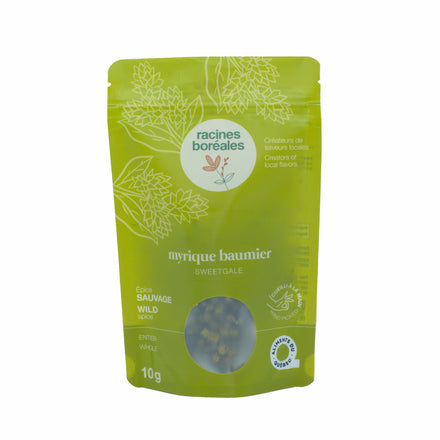
At Racines boréales, we carry Quebec sweet gale in whole dried catkins, ready to use.
It's a niche spice, still little known to the general public, but one that immediately captivates those who discover it. If you love forest flavors and ingredients with character, this is a spice your pantry needs.
Discover this ingredient