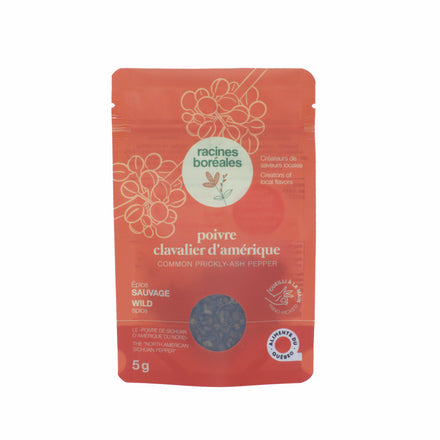

Discovering Common prickly-ash pepper? Taste its flavour — straight from our northern landscapes.
There are spices that perfume. American toothache tree does something rarer: it transforms the mouth experience. A small amount is enough to trigger an electric tingle on the tongue — followed by a wave of citrus, lemon zest, orange peel. It's unexpected, boreal, and absolutely unforgettable.
The Quebec cousin of Sichuan pepper
American toothache tree (Zanthoxylum americanum) belongs to the same botanical family as citrus fruits — the Rutaceae — and the same genus as the famous Sichuan pepper. It's not a pepper in the strict sense: it contains no piperine. It's hydroxy-alpha-sanshool, a compound found in all Zanthoxylum spices, that's responsible for the characteristic numbing effect. Indigenous peoples once chewed its bark and fruits to relieve toothaches — hence its English name, toothache tree.
Today, it's mainly its aromatic profile that captivates chefs: lemony, slightly peppery, with notes of mandarin and lime zest. American toothache tree pepper is powerful, volatile, and has a freshness found in no other local spice.
Dose with precision
Toothache tree should be used sparingly — its aromas are intense and its essential oils very volatile. Too generous a quantity and it overpowers everything else.
Its flavours express themselves particularly well through fat. Incorporated into an oil, butter or creamy sauce, it diffuses its citrus notes in depth.
On fish and seafood — this is the most natural pairing. Its fresh tangy quality plays the same role as a squeeze of lemon, only more complex. Try it in a beurre blanc, on scallop carpaccio, or in a trout marinade.
In infusion — used whole in a hot broth or infused oil, toothache tree releases its aromas progressively. Remove the fruits before serving.
In vinaigrettes and cold sauces — ground or infused in oil, it transforms an ordinary vinaigrette into something far more interesting.
In desserts — with citrus, sea buckthorn, or red berries, the tingle becomes a playful, almost festive sensation.
In homemade chili crisp — toothache tree is the star spice in our chili crisp with American toothache tree and gorria pepper, a recipe that perfectly illustrates how to use it to its full potential.
The American toothache tree plant: a demanding harvest
The shrub grows on dry slopes and wooded edges in Quebec, and can reach two to five metres in height. Its stipules are spiny — extremely hard and sharp — making the clusters nearly impenetrable. Add to this the fact that its essential oils are irritating on contact, which complicates fruit harvesting.
This is what makes it a rare and precious spice. To learn more about the plant, Flore laurentienne provides a detailed botanical description.
Racines boréales American toothache tree
Our American toothache tree is hand-harvested in Quebec. Use it ground or whole in infusion depending on the application. We recommend storing it in the refrigerator to preserve it from premature rancidity — and start with a small amount. It's the kind of spice that surprises every time.
Discover this ingredient