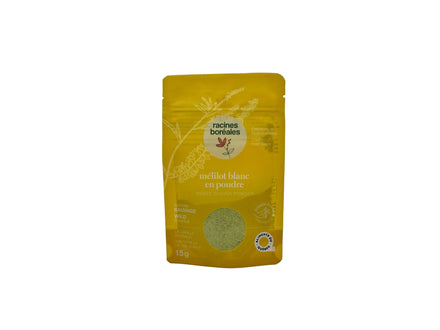

Discovering Powdered white sweet clover? Taste its flavour — straight from our northern landscapes.
White sweet clover (Melilotus albus) is a legume-family plant whose dried flowers are used as a culinary spice. Its aromas — vanilla, almond, fresh hay — evoke the tonka bean and have earned it the nickname "Quebec vanilla," or "boreal vanilla."
Sweet clover — a wild vanilla?
Not quite vanilla — but its fragrance and flavor are strikingly similar. Sweet clover owes its aromas to coumarin, a naturally occurring molecule also found in tonka beans and cherry wood. It is coumarin that creates this captivating scent: sweet, lightly amber, with a hint of dried hay. While it is often compared to vanilla, white sweet clover (Melilotus alba) is very much its own plant, with a character and perfume all its own.
Where does white sweet clover grow in Quebec?
Robust and prolific, white sweet clover grows freely in sunny, open environments: roadsides, abandoned fields, forest edges. It can reach two metres in height and blooms from June through September. It is recognizable by its small white flowers clustered in elongated spikes and by its distinctive fragrance — soft and sweet, most perceptible as the plant dries.
What does it taste like?
Dried sweet clover reveals notes of vanilla, almond, and fresh hay, with a gentle woody undertone. Its aroma is less concentrated than pure vanilla but more complex: floral, lightly caramelized, with a lovely lingering finish.
A note on coumarin
Coumarin, responsible for sweet clover's aromas, is perfectly safe at culinary doses. However, if sweet clover is improperly dried or stored in a humid environment, coumarin can convert into dicoumarol, a natural anticoagulant. When in doubt, always use professionally dried sweet clover, kept away from moisture — such as what we offer at Racines boréales.
White sweet clover in baking
It is in baking that sweet clover truly shines. Sweet clover powder can be added directly to dry ingredients at a 1:1 ratio with vanilla extract: 1 tsp of vanilla extract = 1 tsp of sweet clover powder. Its aroma is more intense and nuanced than an extract — and completely additive-free.
If you've been searching for a sweet clover essence at the grocery store, know that sweet clover powder delivers a far more powerful result in flavor. It blends beautifully into cakes, financiers, crepes, shortbread, and pastry creams.
With whole flowers and stems, infusion is the preferred method:
- In warm cream or milk: for creams, ganaches, panna cotta, or rice pudding
- In a syrup: a few minutes is all it takes to perfume a maple syrup or a simple syrup
What does it pair with?
- Sweet clover-poached pears: poach your pears in a syrup infused with sweet clover flowers — the spice's gentle florality envelops the fruit with subtlety. Also try our pear, sweet clover, and spice tart to go further.
- Whipped cream or chantilly: steep the flowers in cold cream overnight, then whip the next day — a lightly vanilla-scented, floral whipped cream
- Hot chocolate or ganache: a pinch of sweet clover powder in the milk, or whole flowers steeped in the cream
- Rice pudding: as a replacement for or complement to vanilla
- Wild berry tart: folded into the almond cream or pastry cream of a blueberry or haskap tart
Flavor pairings
- Pear: an exceptional pairing — sweet clover's floral softness envelops the fruit without overpowering it
- Wild berries: blueberries, haskap, serviceberries — its vanilla note naturally complements their acidity
- Chocolate: white or milk chocolate, sweet clover extends and deepens its aromas
- Milk and cream: steeped, it perfumes dairy with remarkable subtlety
- Banana, peach, apricot: soft-fleshed fruits that harmonize beautifully with its floral profile
- Honey and maple syrup: a natural boreal combination
Where to find it?
Racines boréales offers Quebec white sweet clover in whole flowers and in powder, harvested and dried in Quebec. An accessible, local spice that deserves a permanent place in your pantry.