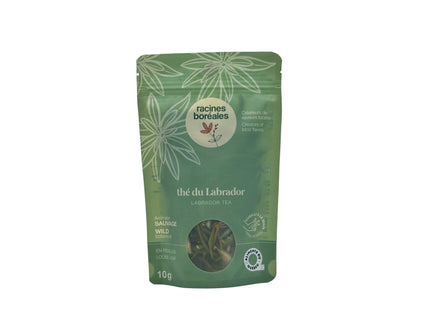

Discovering Labrador tea? Taste its flavour — straight from our northern landscapes.
What is Labrador tea?
Labrador tea (Rhododendron groenlandicum, formerly Ledum groenlandicum, also called Greenland ledum) is a shrub native to North America that grows in peatlands and humid undergrowth in Quebec. Despite its name, it has nothing in common with tea from a botanical perspective — it contains neither theine nor caffeine. It owes its name to the fact that its leaves have been consumed as an infusion for centuries.
It is one of the most emblematic aromatic plants of the Quebec boreal forest, used by Indigenous peoples long before imported tea arrived in America.
What does it taste like?
Labrador tea leaves have a surprising aromatic profile: fresh, minty, slightly sweet, with a touch of resinous and floral notes. The resulting infusion is a pale golden colour, smooth and soothing, with a slight hint of bitterness at the finish.
It's a distinctly forest flavour — neither herbal like a classic tisane, nor woody like bayberry. Something softer, more northern, reminiscent of the undergrowth after rain.
How to prepare the infusion
The simplest and most common method: use about 1 g of dried leaves (around fifteen leaves) per cup, cover with hot water and let steep 4 to 10 minutes, depending on desired strength.
A short infusion produces a light and floral tisane. The longer the infusion, the more bitterness increases — taste over time to find your balance. We recommend not exceeding 10 minutes.
Labrador tea is best enjoyed plain, but also pairs beautifully with a drizzle of honey or other infused plants, notably balsam fir.
Beyond the cup: Labrador tea in cooking
Labrador tea is also an aromatic in its own right. A few uses worth exploring:
In syrup — steep the leaves in simple syrup. The resulting syrup delicately flavours cocktails, yoghurts, or berry desserts.
As an aromatic in braises — add a few leaves to a broth or white bean stew. Its slightly resinous side brings subtle depth without overpowering.
In salmon marinade — a concentrated Labrador tea infusion makes an elegant marinade base for fatty fish. Its fresh and floral notes pair naturally with salmon flesh.
Recipe idea: Labrador tea and blueberry syrup
Prepare a simple syrup, then steep Labrador tea leaves and a handful of fresh blueberries in it. Strain and refrigerate.
Use in homemade lemonade, a boreal gin and tonic, a vinaigrette, or simply drizzled over Greek yoghurt.
What pairs well with it?
Labrador tea pairs particularly well with:
- Blueberries and small berries — a classic boreal terroir combination
- Salmon and fatty fish — the plant's fresh notes lighten the richness of the fish
- Mint — for infusions and cocktails with summery undertones
- White beans — in soups or stews
Where does Labrador tea grow?
Labrador tea is a typical plant of humid and acidic environments in Quebec — peatlands, lake shores, black spruce undergrowth, where it grows alongside wild blueberries and cranberries. It is a slow-growing species requiring responsible harvesting: it's recommended to take no more than a third of the leaves from any one shrub and not to return to the same location for three years in a row.
In Quebec, commercial harvesting of Labrador tea requires a permit. At Racines boréales, we work exclusively with harvesters who hold one — because preserving these species for future generations is part of how we do business.
Our leaves are hand-harvested in Quebec, in respect for the plant and its ecosystem. To learn more about the botany of Greenland ledum, UQAC's Nourishing Forest offers a detailed fact sheet.
Racines boréales Labrador tea
At Racines boréales, we offer Quebec Labrador tea in dried leaves, responsibly hand-harvested.
Note: Labrador tea is not recommended for pregnant women or children under five years old.
Discover this ingredient